
Compressed Air Pressure Drop: Causes, Calculation, and How to Reduce It
Compressed air is an essential utility in modern industrial facilities. It powers pneumatic tools, automated production lines, packaging machines, assembly equipment, and a wide range of manufacturing processes. However, one common problem faced by factories is compressed air pressure drop
When compressed air travels from the compressor to the point of use, its pressure can decrease because of friction, undersized pipes, excessive fittings, air leaks, and other system restrictions. If the pressure loss becomes too high, pneumatic equipment may operate inefficiently, production may slow down, and energy consumption can increase.
Understanding the causes of pressure drop and knowing how to calculate and reduce it can help businesses improve system performance and control operating costs.
In this guide, we explain what compressed air pressure drop is, why it happens, how to calculate it, and which practical solutions can help maintain reliable airflow throughout an industrial piping network.
What Is Compressed Air Pressure Drop?
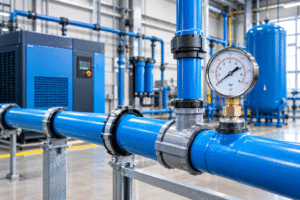
Compressed air pressure drop is the reduction in air pressure between two points in a compressed air distribution system.
For example, an air compressor may deliver air at 8 bar, while a pneumatic machine located at the end of a long piping network receives only 6.8 bar. The difference of 1.2 bar represents the pressure drop between those measurement points under the operating conditions.
Pressure drop occurs because compressed air encounters resistance while moving through pipes, elbows, tees, valves, filters, hoses, and other components.
A small pressure drop is normal in every compressed air system. However, excessive pressure loss can prevent equipment from receiving the pressure it needs to operate properly.
Example:
-
Compressor outlet pressure: 8 bar
-
Pressure at the machine inlet: 7 bar
-
Pressure drop: 1 bar
In this example, the system loses 1 bar between the compressor outlet and the machine inlet.
The acceptable pressure drop depends on the application, equipment requirements, system design, and the manufacturer’s recommendations.
Why Is Compressed Air Pressure Drop a Problem?
Excessive pressure loss can affect both productivity and operating expenses.
1. Reduced Machine Performance
Pneumatic tools, cylinders, and automated machines require an appropriate operating pressure. When the available pressure falls below the required level, equipment may operate more slowly, deliver less force, or fail to complete its intended operation.
2. Increased Energy Consumption
Factories sometimes increase compressor discharge pressure to compensate for losses in the distribution system. This can increase compressor energy consumption without addressing the underlying problem.
Reducing unnecessary pressure losses can help avoid the need to operate at a higher discharge pressure.
3. Production Delays
Pressure fluctuations can affect several machines, particularly when multiple processes operate simultaneously. Inconsistent air supply may interrupt production cycles or reduce process reliability.
4. Higher Maintenance Requirements
Restrictions, leaking connections, clogged filters, and poorly designed piping can contribute to recurring operational problems. Identifying these issues early can help reduce unnecessary maintenance.
Common Causes of Compressed Air Pressure Drop
Understanding the source of pressure loss is the first step toward finding an effective solution.
1. Undersized Air Pipes
Pipe diameter has a significant effect on airflow resistance. When a pipe is too small for the required airflow, air velocity increases and friction losses can become excessive.
This problem is especially common when a facility expands production but continues using its original piping network.
Solution: Select pipe diameters based on airflow demand, pipe length, operating pressure, allowable pressure drop, and expected future expansion.
2. Long Piping Distances
Compressed air experiences friction as it moves through a pipe. Longer piping routes generally create greater resistance, particularly when pipe diameter is insufficient.
Poorly planned routes can also increase the amount of piping and the number of connection points required.
Solution: Plan efficient distribution routes and size pipes appropriately for the entire system rather than selecting them based on distance alone.
3. Too Many Elbows, Tees, and Fittings
Elbows, tees, valves, reducers, and other components introduce additional resistance to airflow. A system with many unnecessary changes in direction may experience higher pressure losses.
Solution: Minimize unnecessary bends, use appropriately sized fittings, and select components designed for the intended airflow and operating conditions.
4. Air Leaks in the Distribution Network
Leaks can occur at joints, connectors, valves, hoses, and damaged pipe sections. They waste compressed air and increase the demand placed on the compressor.
Although leaks are not the same as frictional pressure loss, they can contribute to low pressure at points of use by increasing total system demand.
Solution: Inspect connections regularly, repair leaks promptly, and establish a routine leak-detection programme.
5. Clogged Filters and Restricted Components
Air filters remove particles and, depending on their design, other contaminants. As filter elements become clogged, the pressure difference across them can increase.
Regulators, valves, separators, and other components can also restrict airflow if they are incorrectly sized or poorly maintained.
Solution: Monitor differential pressure, maintain components according to the manufacturer’s instructions, and select equipment suitable for the required flow rate.
6. Poor Piping Layout
A distribution network with long, complicated routes, inadequate pipe sizing, and poorly positioned branches may struggle to deliver consistent pressure.
Solution: Design the system around actual demand. In suitable installations, a properly sized ring-main distribution arrangement can provide multiple flow paths and help reduce pressure variations.
A ring main is not a substitute for correct sizing: the pipe network, branches, fittings, and connections must all be designed for the required flow.
7. Sudden Changes in Air Demand
When several pneumatic machines start simultaneously, total airflow demand may rise sharply. If the compressor, receiver, or distribution network cannot meet this demand, pressure at the equipment may fall.
Solution: Review peak airflow demand, compressor capacity, receiver sizing, and distribution pipe capacity. Consider whether demand-management measures or additional storage are appropriate.
How to Calculate Compressed Air Pressure Drop
Pressure drop is calculated by comparing pressure at the beginning and end of a section of the compressed air system.
The basic formula is:
Pressure Drop = Inlet Pressure − Outlet Pressure
Where:
-
Inlet pressure is the measured pressure before the section being evaluated.
-
Outlet pressure is the measured pressure after that section.
Both pressure readings must use the same units and be taken under comparable operating conditions.
Example of Pressure Drop Calculation
Suppose an industrial facility records the following readings:
| Measurement | Pressure |
|---|---|
| Compressor outlet | 8 bar |
| Main distribution line outlet | 7.6 bar |
| Machine inlet | 7.1 bar |
The pressure drop across the main distribution line is:
8 − 7.6 = 0.4 bar
The additional pressure drop between the distribution line outlet and the machine inlet is:
7.6 − 7.1 = 0.5 bar
The total pressure drop from the compressor outlet to the machine inlet is:
8 − 7.1 = 0.9 bar
These measurements suggest that both the main distribution line and the downstream section should be investigated.
How to Calculate Pressure Drop as a Percentage
The percentage pressure drop can be calculated as:
Pressure Drop (%) = (Pressure Drop ÷ Inlet Pressure) × 100
Using the example above:
(0.9 ÷ 8) × 100 = 11.25%
This means the measured pressure decrease is 11.25% of the initial pressure reading.
Percentage pressure drop is a useful way to describe the loss, but it does not determine whether the system is acceptable. That decision depends on the required pressure at the equipment and the design criteria for the installation.
How to Calculate Pressure Drop in a Pipe
Calculating the actual pressure loss in a compressed air pipe requires more information than simply knowing the pipe length.
Important factors include:
-
Pipe internal diameter
-
Total pipe length
-
Airflow rate
-
Operating pressure and temperature
-
Pipe material and internal surface characteristics
-
Elbows, tees, valves, and other fittings
-
Changes in elevation and system configuration
Engineering calculations or appropriate compressed-air sizing tools should be used to estimate pressure loss under the expected operating conditions. For more complex systems, specialist design software or an experienced compressed-air system engineer may be needed.
A pipe-sizing chart can provide an initial estimate, but the final selection should account for actual demand, the allowable pressure drop, and future expansion.
How to Reduce Compressed Air Pressure Drop
Reducing pressure loss starts with identifying where the pressure is being lost and why.
1. Choose the Correct Pipe Diameter
Correct pipe sizing is one of the most important ways to control pressure drop.
A pipe that is too small creates unnecessary resistance, while a properly sized pipe helps deliver the required airflow with lower friction losses.
When selecting a pipe diameter, consider the maximum expected airflow, distribution distance, operating pressure, and allowable pressure drop.
2. Use an Efficient Compressed Air Piping System
The quality and design of the piping network affect airflow, installation efficiency, maintenance, and long-term reliability.
A suitable industrial piping system should offer appropriately sized pipes, compatible fittings, secure connections, and a layout that meets the facility’s operating requirements.
Quickair’s modular piping solutions can be evaluated for suitable compressed-air distribution applications where efficient installation and a well-organised pipe network are priorities.
The correct system should always be selected according to the required pressure rating, airflow, application, and manufacturer’s specifications.
3. Reduce Unnecessary Bends and Restrictions
Every elbow, valve, and fitting should serve a clear purpose. Avoid unnecessarily complicated pipe routes and check that fittings do not create avoidable restrictions.
Use correctly sized components and follow recommended installation practices.
4. Detect and Repair Air Leaks
Regular leak inspections can help reduce wasted compressed air and improve pressure stability.
Pay particular attention to connection points, flexible hoses, isolation valves, and older sections of the network.
Repairing leaks may reduce compressor demand and improve the amount of air available for production equipment.
5. Maintain Filters, Regulators, and Valves
Inspect air-treatment components according to their maintenance requirements. Check differential pressure across filters and replace elements when indicated by the manufacturer’s recommendations.
Verify that regulators, valves, and other components are appropriately sized for the expected airflow.
6. Measure Pressure at the Point of Use
A compressor’s discharge pressure does not necessarily represent the pressure available to a machine.
Install or use suitable pressure gauges at important points, such as the compressor outlet, main distribution line, and equipment inlet. Take measurements during normal operation and periods of high demand.
Comparing these readings helps identify where the greatest losses occur.
7. Review the Distribution Network as Demand Grows
Production expansion can increase the demand placed on an existing piping network.
Before adding new equipment, review the expected airflow, peak demand, pipe capacity, and compressor performance. A system that worked well for a smaller installation may require upgrades as the facility grows.
What Is an Acceptable Pressure Drop in a Compressed Air System?
There is no single pressure-drop limit that applies to every industrial installation.
The acceptable loss depends on the compressor operating pressure, the equipment’s minimum required inlet pressure, the piping arrangement, air-treatment requirements, and the intended application.
As a preliminary design objective, engineers often aim to keep distribution pressure losses to a small fraction of the available pressure. The appropriate target should be established using recognised engineering guidance and the equipment manufacturer’s specifications.
It is also important to distinguish pressure loss in the distribution pipes from pressure loss across filters, dryers, regulators, and other air-treatment components. Each section should be assessed separately before deciding where improvements are needed.
Compressed Air Pressure Drop Troubleshooting Checklist
Use the following checklist when investigating low air pressure in a factory.
-
Measure pressure at the compressor outlet and the equipment inlet.
-
Compare readings during low-demand and peak-demand periods.
-
Inspect pipes for undersized sections or unnecessarily long routes.
-
Check elbows, tees, valves, and connection points.
-
Inspect filters and measure differential pressure where appropriate.
-
Identify and repair compressed-air leaks.
-
Confirm that the compressor can meet peak airflow demand.
-
Review the distribution network if additional equipment has been installed.
-
Verify that the equipment receives its required operating pressure.
-
Record measurements and review the results after making changes.
Following a structured process helps maintenance teams avoid making costly upgrades before identifying the real source of pressure loss.
Conclusion
Compressed air pressure drop is a common industrial challenge that can affect equipment performance, production reliability, and energy costs. Common causes include undersized pipes, long distribution routes, excessive fittings, leaking connections, clogged filters, and sudden increases in air demand.
By measuring pressure at key locations, calculating the difference between readings, selecting appropriately sized piping, maintaining components, and repairing leaks, facilities can improve compressed-air distribution and reduce unnecessary pressure losses.
A properly designed piping network is essential for delivering the required airflow to equipment reliably. When planning a new installation or upgrading an existing system, consider the complete distribution network, including pipe sizes, fittings, connections, and expected future demand.
Looking for a reliable industrial compressed-air piping solution? Explore Quickair’s modular piping system and contact the team to discuss your application’s requirements.
Website: https://staging.quickair.in/
Contact: +91 94480 66046
Frequently Asked Questions
1. What causes compressed air pressure drop?
Common causes include undersized pipes, long pipe runs, friction, excessive fittings, air leaks, clogged filters, restricted valves, and sudden increases in airflow demand.
2. How do you calculate compressed air pressure drop?
Subtract the outlet pressure from the inlet pressure. For example, if the inlet pressure is 8 bar and the outlet pressure is 7 bar, the pressure drop is 1 bar.
3. How can I reduce pressure loss in compressed air pipes?
Use correctly sized pipes, reduce unnecessary fittings, maintain filters and valves, repair leaks, and measure pressure at important points throughout the network.
4. Does pipe diameter affect compressed air pressure drop?
Yes. Pipe diameter affects airflow velocity and friction losses. A pipe that is too small for the required airflow can create excessive pressure loss.
5. Can air leaks cause low pressure in industrial equipment?
Yes. Leaks increase the total compressed-air demand and may reduce the pressure available to equipment, particularly during periods of high demand.
6. How often should compressed air piping be inspected?
Inspection frequency depends on operating conditions, system criticality, and the manufacturer’s recommendations. Regular inspections and ongoing leak monitoring can help identify developing problems before they affect production.
7. Can a modular piping system help reduce pressure drop?
A properly designed modular piping system can help improve distribution efficiency through suitable pipe sizing, compatible fittings, and an efficient layout. Actual performance depends on the complete system design, airflow requirements, installation quality, and operating conditions.